

Lab, imaging and the pharmacist
The Orders and Results tile runs lab and imaging orders side by side until every result is back. Three care models in the group CARE, DIAGNOSTICS AND OBSERVATION draw that work in more detail: Lab in Detail, Imaging in Detail and ED Pharmacist. Each is placed from the palette or switched on in a scenario, and none needs another care model. See Care models for the marks and Add, move and remove a care model for placing one.
Lab in Detail
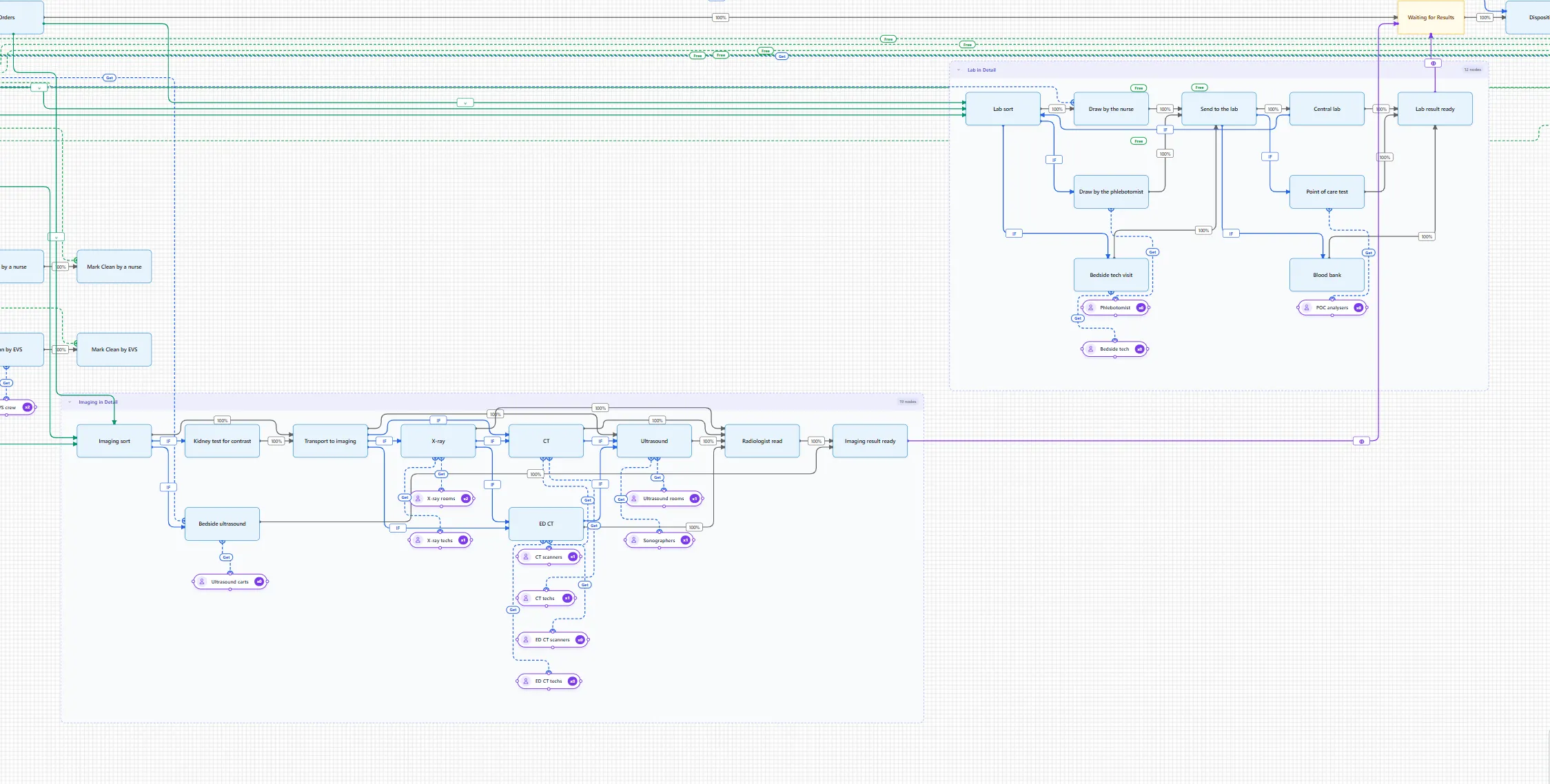
Section titled “Lab in Detail”“Each lab order is drawn, sent and run, with an optional phlebotomist, bedside tech or point of care.” It is marked from any size. Think of it as a way of drawing the lab, not a practice a department adopts.
Each order becomes its own steps: the sample is drawn, sent in the tube, and run at the central lab, at the point of care or at the blood bank. A hemolysed sample goes back to be drawn again. The draw takes 3 to 8 minutes and the tube 1 to 2.5. The central lab keeps its turnaround by acuity, so a detailed order takes longer from order to result than the simple Lab does, by the draw and the send.
By default the triage nurse draws, so triage can wait longer in a busy hour. A phlebotomist or a bedside tech draws while one is free, and takes that load back from the triage nurse. Phlebotomists, bedside techs and point of care analysers all start at 0, and add nothing to the cost until you raise them. A share of tests, by acuity, can be run at the bedside with the analysers. A share set for the blood bank goes there: an emergency issue for ESI 1 and a type and screen for the rest.
In a scenario the boxes are Who draws the sample, Nurse redraws, percent, Skilled redraws, percent, Runner instead of tube, Point of care share, percent, Blood bank share, percent, Phlebotomists, Bedside techs and Point of care analysers.
Imaging in Detail
Section titled “Imaging in Detail”“Each imaging order is taken to its scanner, scanned and read, with an optional ED CT scanner or bedside ultrasound.” It is marked from any size.
Each order is sorted, taken to its scanner, scanned and read, as its own steps. Transport takes 5 to 20 minutes, and 5 to an ED CT. A contrast CT first waits for a kidney test. A patient with two studies done one after the other is scanned twice, and two studies done together take the slower of the two. From the scan to the result, the turnaround by type and acuity is kept, so a detailed order takes the transport, the kidney test and any wait for a scanner longer than the simple Imaging does.
It adds X-ray rooms, a CT scanner and an ultrasound room, with an X-ray tech, a CT tech and a sonographer. Two options start at 0 and add nothing until you raise them. An ED CT scanner, with its ED CT techs, takes CT orders while it is free. Ultrasound carts let the provider scan a share of the ultrasound-only orders at the bedside, which takes 10 minutes of the provider’s time, outside the provider’s caseload.
In a scenario the boxes are Contrast CT kidney test, percent, Bedside ultrasound share, percent, X-ray rooms, X-ray techs, CT scanners, CT techs, Ultrasound rooms, Sonographers, ED CT scanners, ED CT techs and Ultrasound carts.
ED Pharmacist
Section titled “ED Pharmacist”“After the exam a first dose is checked, fetched and given; an ED pharmacist checks it sooner.” It is marked Possible from 22,000 visits and Suited from 44,000.
After the exam, a patient who needs a first dose, by acuity, has the order checked. The ED pharmacist checks it in the pharmacist’s hours, while one is free, in 3 to 21 minutes. Otherwise the central pharmacy checks it, in 5 to 45. The dose then comes from the cabinet in 1 to 5 minutes, from the central pharmacy in 20 to 60, or from the IV room in about 105. The dose is given in no time of its own.
A septic patient’s first dose is the antibiotic, and giving it stops the door to antibiotic clock. A copy of the patient takes this path beside the patient’s care, so nothing waits for it: orders and the disposition go on as before. The care model adds a patient type, Medication, one ED pharmacist and a dispensing cabinet. The pharmacist, the cabinet, the first doses and the sepsis antibiotic all have a cost, which the card shows. Medication reconciliation for admitted patients is not drawn yet.
In a scenario the boxes are Pharmacist starts, Pharmacist ends, First dose share, percent, Sepsis share, percent and ED pharmacists. A kind of step, Antibiotic, is among the kinds a step can have.
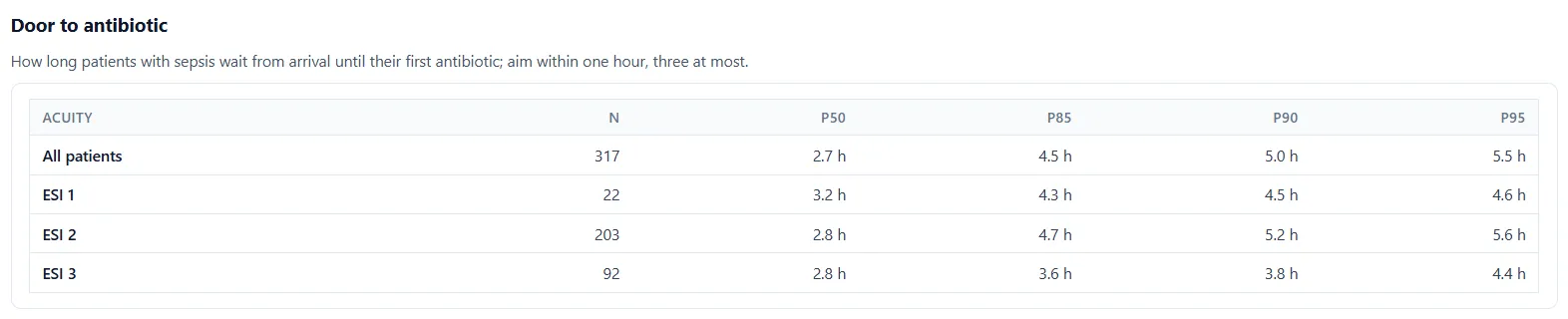
Door to antibiotic
Section titled “Door to antibiotic”The Flow tab of the report has a table, Door to antibiotic, by acuity. Its hover reads “How long patients with sepsis wait from arrival until their first antibiotic; aim within one hour, three at most.” The table is drawn only when the run holds rows for it, which in practice means a model with the ED Pharmacist care model: without it the Flow tab has no Door to antibiotic table. See The emergency department report tabs.
Where to read more
Section titled “Where to read more”- Care models: the marks and the boxes of all nineteen.
- Care models for the front door and the streams: Nurse Standing Orders starts the same tests at triage.
- The emergency department report tabs: the Flow tab.
- Settings for an emergency department model: the kinds of step, among them Lab sort, Imaging sort and Antibiotic.