

Process improvement
Find the real constraint, test the change before you commit, and prove the gain. Ideas and methods for improving the way work flows.
 Process improvement
Don't leave money on the table, use process optimization
When a system has thousands of possible configurations, finding the best one by hand is hopeless. PM Optimizer runs the experiments for you and searches for the best answer in a fraction of the runs it would take to try them all.
Read Process improvement
How can you get lean when the fat keeps moving?
Spot-reducing one part of a process rarely moves the whole system. To get truly lean, you have to see the ripple effect everywhere, which is where value stream simulation goes beyond the map.
Read Process improvement
How to overcome obstacles in process improvement
Process improvement interviews can hand you years of insight in an hour, if you can get past the stalling, defensiveness, crowded rooms, and red herrings. Here are the common obstacles and how to clear them.
Read Process improvement
Job shop bottleneck analysis and process improvement
In a job shop, every batch can take a different path through the machines, so the bottleneck moves with the work. A purpose-built model finds the constraint for the production you actually run.
Read Process improvement
Justifying simulation for process improvement
Spreadsheets and averages only take process analysis so far. See how simulation pays for itself through accurate modeling, optimization, deeper system insight, and animation that sells change.
Read Process improvement
Maintaining your process improvement efforts
The hardest part of process improvement is keeping the momentum going after the first win. Here are the ProcessModel resources, services, and support that help you sustain it.
Read Process improvement
The number one process improvement blunder
Most process improvement programs fall short for three avoidable reasons. Each traces back to one root cause, and the same root cause points straight to the fix.
Read Process improvement
Process simulation beats SAP on time and budget
SAP earned its place as an ERP giant, but its size, cost, and rigidity show their age. Process simulation offers a faster, cheaper, more adaptable way to optimize your processes, and the numbers back it up.
Read Process improvement
Start leading with process improvement
Management is always hunting for the projects that move the bottom line. This is a field guide to finding the right ones: how to identify, analyze, redesign, implement, and evaluate a process so the gains are real and they last.
Read Process improvement
Ten benefits of business process simulation
Business process simulation lets you model how work really behaves, then test changes before you commit to them. Here are ten ways it pays off.
Read Process improvement
Ten tips for buying any process improvement tool
A canned demo shows what a vendor does easily, not what you actually need. Ten questions to ask before you buy any process improvement tool, so the purchase fits your problems and your budget.
Read Process improvement
The 15-minute fix that changed everything
Sarah knew her onboarding process felt slow, but with dozens of steps she had no idea where to start. The Hot Spot Evaluator found the answer in seconds, and one small change cut onboarding time by 44%.
Read Process improvement
Three tricks for developing better process models
A procedural guide rarely matches how a process truly runs. These three field-tested tricks, walk it, build it the same day, and simulate the flow first, capture the real process fast and accurately.
Read Process improvement
Value stream mapping will slow production and increase costs
Value stream mapping is an excellent tool on the processes it was designed for. Use it on a highly variable process and its key value, simplicity, turns into a liability. Here is when to model instead.
Read Process improvement
Variability affects throughput
Intuition says a chain of workers averaging 3.5 units each will move 3.5 units overall. Goldratt's dice-and-matchsticks game shows it moves far less, and the gap is about 28%. Here is why variability quietly steals throughput.
Read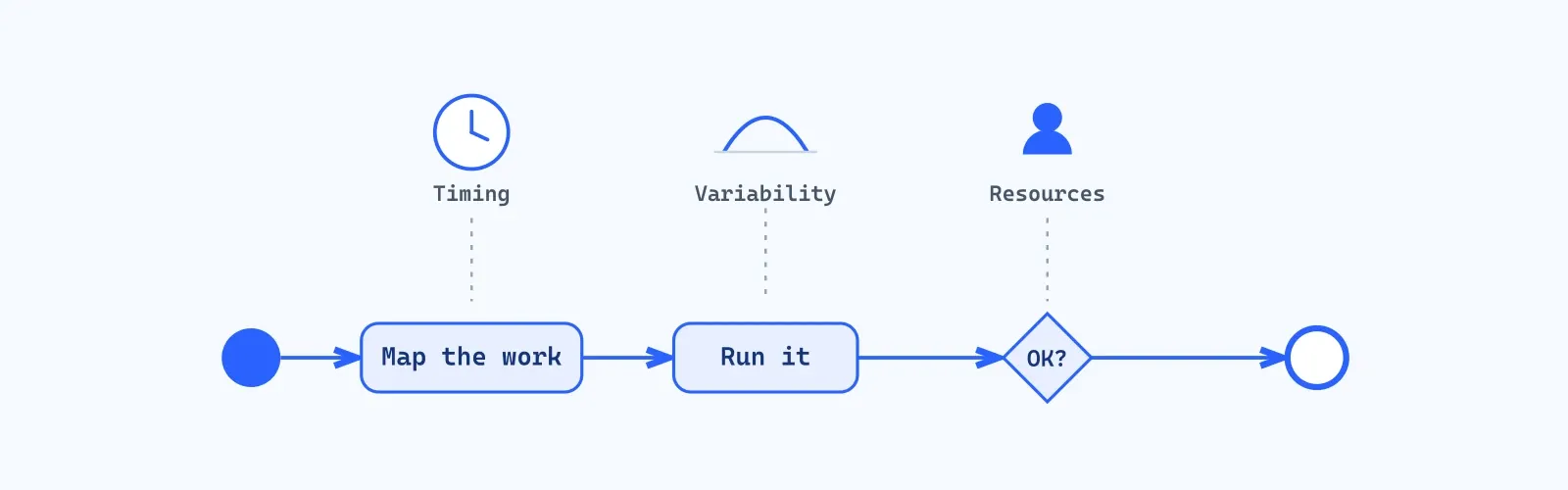 Process improvement
What is a process?
A process is a series of steps and decisions involved in completing work. But the standard definition leaves out the three things that decide how a process really behaves: timing, interdependency, and variability.
ReadSee your process clearly, then prove the fix
Build the model, run the simulation, find the constraint, and show the improvement before you change a thing.