
Value stream mapping will slow production, increase costs, and destroy your company’s profitability
See the five process problems most companies experience, why they cannot be solved with value stream mapping (VSM), and how you can solve them with ease.
Do not get me wrong. Value stream mapping is an excellent tool when used on the right processes. To be blunt: if VSM is accurately representing your processes, stop reading, because this article is not going to help you.
But if you have not noticed, VSM is not suited to some processes. Here is a quick overview. A value stream map is a “snapshot” of a system. It is a picture of the basic flow overlaid with collected data, and its intent is to show where the waste is. As a leader of 30 consultants put it, “It’s a ‘back of the envelope’ method of finding problems.”
VSM is fast and effective on the processes it was designed for. It was developed for auto manufacturing, whose characteristics are:
-
Well defined
-
Tightly controlled
-
Low product variability
-
Low variability in production timing
-
Low variation in routing
-
Low variation in production schedule
As you step further from the characteristics VSM was built for, its value erodes exponentially. Variation in the process flow makes the diagram confusing. Variation in processing time, product mix, or scheduled volume makes the diagrams unreliable. A diagram whose whole value is simplicity becomes deceptive.
If you are making decisions from a value stream map and the picture changes throughout the day, you are more likely to do harm than good. Used on processes with characteristics it was not designed for, VSM will slow your production, increase your costs, and damage your company’s profitability.
What is my alternative?
Build a dynamic model of the process. ProcessModel simulation software lets you create a simple working model of processes that do not fit the VSM mold. A model shows you behaviors a value stream map would hide. You can watch it run, observing bottlenecks, delays, and other waste. You can capture operational statistics just like you would on the real system. Apply your lean techniques to the simulated version, and prove planned changes in seconds. Changes that do not meet your criteria cost you nothing, because they happen in a virtual environment. Modeling replaces value stream mapping and lets you use lean techniques in a simulated setting.
Would you like to use your lean techniques more effectively? Request a trial version of ProcessModel.
Why can’t I just simulate the value stream?
Great question. In controlled processes with low variation in arrivals, routing, and timing, this is not a bad idea. You gain the ability to make a change and have the system adjust and recalculate as if it were the real thing. That means you can run a Kaizen on the model rather than the real system and see results in seconds. But you also need to add many elements that would not appear on a value stream map, along with many more reports and capabilities. And now it is a simulation. It would be like hiding a high-performance car under a golf cart body and still running it on the cart engine.
If the process strays from the ideal characteristics for a value stream map, the key value of VSM goes to zero. Now you have a poor representation of a complex system, and the values it reports are meaningless. Using a value stream map to portray a highly variable process does not make sense in any situation.
Learn what type of processes are suited for simulation
Processes best suited to modeling and simulation tend to have some of the following characteristics:
-
Using the same resource at several stations or across several processes
-
Variability in arrivals
-
Variability in product mix
-
Variability in processing times
-
Variability in route selection
-
Rework
Resources shared by different processes
Manufacturing, service, and healthcare systems often face a common problem: several departments share a common resource.

At Boston Medical Center, the Emergency, Inpatient, and Outpatient departments all share a multi-million-dollar CT scanner. The equipment is expensive, requires highly trained staff, and cannot be moved. The level of use does not justify any one department owning its own scanner. When you use VSM to picture how the system looks and behaves, which department do you use, Emergency, Inpatient, or Outpatient? Changing the value stream of one process is often disastrous to another. Many shared-resource problems, across many industries, go unsolved because the solution is multi-dimensional and hard to handle with traditional VSM. With simulation, you attach a resource to multiple processes and see the results. Test a change to one value stream and immediately see its effect on the others.
Product mix changes frequently
In assembly processes with expensive items, it is common to run more than one type of product on the same line at the same time. Product mixing means several products, each with unique assembly times, requirements, and routing, are present on the same line at once.

The mix may change from day to day, and even during the day. Creating a clear picture of the problem with traditional VSM is overwhelming. A snapshot of how things look now may look completely different in a few hours. Traditional VSM becomes ineffective because you would need many pictures to capture the behavior, and which of those pictures would you decide from? With simulation, you see the big picture and can be confident your changes work for statistically accurate mixes of entities.
High variability in processing times
In many service and healthcare systems, variability is a tougher problem than in manufacturing, where the inputs are controllable. With traditional tools, variability gets reduced to averages. Using averages to decide on a complex system is like using a chainsaw to perform surgery. The results are never going to be right. A simulation shows the effects of variability. Built-in tools convert raw data into useful representations of that variability, so you see the problems it causes and your solutions account for it.
High variability in routing selection
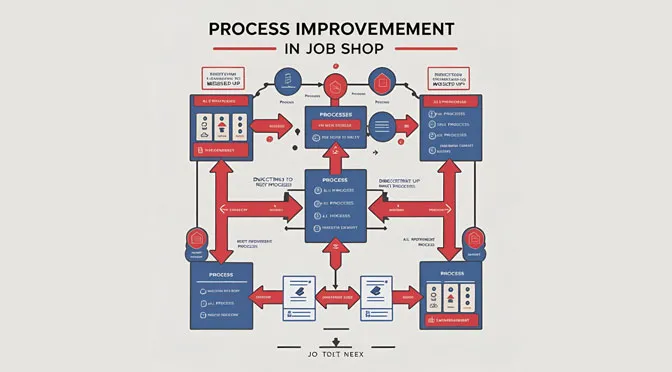
High variability in routing often brings to mind a manufacturing job shop. Every order can move across the machines in a unique sequence. This is often described as having “no process,” but that description is simply inaccurate. Every order has a tightly defined process; it is just hard to describe with a single picture like a value stream map.
This is not limited to job shops. Healthcare has many such problems, including the laboratory, the emergency department, and inpatient flow. Many general service processes behave the same way. Again, traditional VSM cannot create a representative picture of this type of system, and a single picture provides little insight. Simulation allows for analysis of near-infinite routing variation. For a deeper look, see job shop bottleneck analysis.
Rework
A lean practitioner cringes at the word “rework” because it means the system has a built-in quality problem. In the lean world, allowing built-in rework is costly, time-consuming, and just wrong. It goes against the very nature of lean teaching. But reducing rework takes time. At one company, we watched it take over a year to correct a design that caused manufacturing failures. In the meantime, the company still had to meet production requirements until the engineering changes rippled through the system.
The problem with accounting for rework is that it pushes work back into the existing processes. Calculating the effect of this random rework is difficult. If the rework is relatively small, a VSM can ignore it and present a clean picture of the system.
If rework is relatively high, the variability it introduces does not let VSM paint a clear picture of the problem or show the result of changes. In a simulated system, rework can be added and removed with a few keystrokes, and calculating its effects is effortless.
Each of the processes above goes beyond the usefulness of VSM. When you make changes to complex systems, you are changing a multi-dimensional problem. Attempting that with a value stream map is asking for slower production, higher costs, and damage to your company’s profitability.
Improve company profitability
With ProcessModel it is possible to see process problems clearly, and it is easy to predict what will happen when you change a complex process.
Predicting the results of changes to complex processes is the reason ProcessModel exists. Expand your toolbox and see how ProcessModel helps you make the most of your lean training. Request your free personal version of ProcessModel, or look at the industries we serve.