


In Chapter 14 of The Goal, Goldratt presents the dice-and-matchsticks game. The setup is simple. Five people each take matchsticks from the bowl to their left, if there are any, and pass them to the bowl on their right. The first person draws from an effectively infinite bowl, so they always have matchsticks to move. Each person has a random efficiency, transferring anywhere from 1 to 6 matchsticks per round, decided by a dice roll. The catch is that you can only pick up what is actually there. If a person wants to move 6 matchsticks but only 2 are in their source bowl, they move just those 2.
This game strips away the distractions of a complex manufacturing problem. There are no shifts, no downtime, no processing time, no move time, no cadence. What remains lays bare how variability affects total throughput.
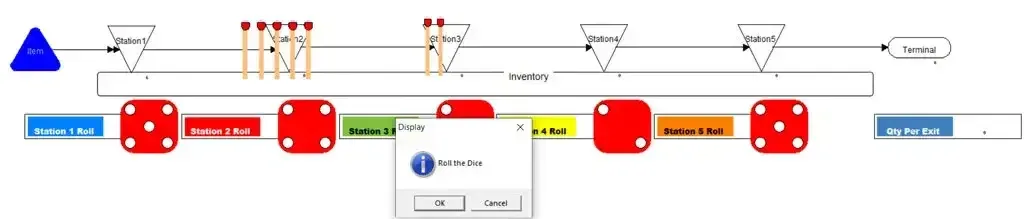
You can download the dice-and-matchsticks model and run it in ProcessModel to see the results firsthand.
Is your intuition right?
A chain of workers tries to pass matchsticks to the right, and because each draw is random between 1 and 6, the first worker moves 3.5 matchsticks per turn on average. It is tempting to assume the whole chain shares that efficiency and also moves 3.5 matchsticks per turn. It does not. The difference between that assumption and the statistically calculated result is about 28%.
| Simulation Results | Number of matchsticks exiting system per roll |
|---|---|
| 100 rolls, 30 replications | 2.41 |
| 1,000 rolls, 30 replications | 2.59 (a 7.2% improvement in accuracy) |
| 10,000 rolls, 30 replications | 2.64 (a 1.9% improvement in accuracy; 10,000 rolls x 30 replications provides 300,000 samples) |
Why is total throughput so much lower than expected?
The throughput lost to each station’s variability is the key lesson of this exercise, and it applies to every service and manufacturing system. When a station is expected to move a certain quantity forward but not enough is available, that production is lost forever. The same principle holds for time, not just quantity. That is why systems underperform expectations whenever the plan was built on averages.
What other lessons come from this example?
More samples buy more accuracy, but at diminishing value
Adding samples improves the accuracy of the calculation. Before chasing that accuracy, though, consider the accuracy of your inputs. If your input is good to plus or minus five percent, there is little point running excessive samples to gain precision the inputs cannot support. On the other hand, if your inputs are accurate to a hundredth of a percent, increasing the number of samples becomes essential.
Calculating throughput by hand is hard
Most calculations assume an average production rate, because handling variability is genuinely complex. Yet averaging would be off by roughly 30%. How would you calculate the throughput of this system manually, and once you had a number, how would you check it? Most people lack the skill to accurately calculate the throughput of even this simple system. And suppose you could, and could verify it. What would you do when management changed how the system worked, or wanted to compare several options? What if, instead of five identical stations, each station differed, or held more stations of its own? How would you convince your audience that your predictions were right?
This is exactly where process simulation earns its place. It accommodates variability directly, reflects the real impact on your throughput, and lets you test option after option in minutes instead of arguing over hand calculations. If you want to feel the effect of variability for yourself, try it inside ProcessModel.