

Most people have a natural aversion to change, especially when it challenges the way they already work. That makes buy-in for process improvement hard to win. To make meaningful improvements, you have to clear the major obstacles that show up in process improvement interviews.
Interviews are one of the best windows into how a process actually behaves, which is exactly what you need to find where it can improve. Clearing these obstacles is a crucial step in the journey. It opens the door to an approach that is more effective, more efficient, backed by key stakeholders, and far more likely to deliver the results you are after.
Interviews can be fast paced and genuinely exciting, handing you insight that might otherwise take years to acquire on your own. That said, things can go wrong before the interview, during it, and while you are getting sign-off on the finished improvement model. Here are the most common process improvement interviewing problems.
Stalling, when you cannot get an appointment
Everyone is busy, but some people will stall for days to avoid being interviewed. Test how real that is with the 1-3-All technique. Start by suggesting one specific time. If that does not work, offer three alternatives.

If they turn down all three, tell them you will open your whole schedule, before work, at lunch, and after work. If they still hesitate, you can be fairly sure it is not really about how busy they are. They got the wrong message, or no message at all, when the project was announced, and they are worried about what it means for their department, their team, or their own job.
When the message went astray, ask for ten minutes to show them what you are doing. Go to their desk with your laptop and walk them through a process. A demonstration file like the hearing model that ships with the software works well. Help them see that you will do the same thing for their process. Most of the time they warm to the idea that they get to take part in the change, and you can set an interview time. If that still fails, you will have to pull rank, because someone did not get the message that everyone was expected to cooperate. Ask the senior manager or the designated appointee to get the message out to the right people. An interview under duress is not ideal, but it beats having no information at all.
Defensiveness
When an interviewee takes offense at questions about their process, it is usually because they think they are being pushed toward something that is not in their interest. You may need to back up and find which part of the message was unclear. If someone believes the effort is really about downsizing, and that their job is on the line, when it is not, you will need to make the case for why the project matters to them, to the customer, and to the company.
Sometimes they have good reason to be defensive. If the capture would show that they are the bottleneck, they have every incentive not to reveal the source of the problem. Stick to isolating one entity type at a time and gather what you can. You may need to back into some of the information by talking to the groups that feed them work and the groups they supply.
Too many cooks in the kitchen
Some groups will want the whole team in the interview. They will say “we get a better picture if everyone is here” or “let’s get it over with all at once.”
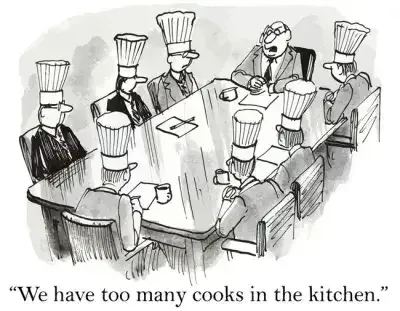
There is no situation where having more than one person in the interview helps. From experience, it takes longer and the result is no better. What usually happens is that people who are normally confident start looking to others for the answer. The group debates, adds steps, removes steps, and never reaches a conclusion. At one of the top consulting firms in the US, we interviewed six people in a room and after a full hour could agree on only one activity step. Interviewing many people at once does not work.
If you are put in that situation, do the kickoff portion of the interview, then explain that you want to interview one person at a time and will provide a model as the starting point for the next interview. Then promptly send the extra people out of the room. Do not continue until the room is clear.
The process improvement micro-manager
Sometimes the supervisor or boss wants to sit in to see how things are done. The trouble is that the process expert will not speak freely about the process, their frustrations, or their ideas for the future in front of the supervisor. The supervisor is seen as a guardian of information that outsiders should not have, and would rather not have people outside the department learn that things are not running as efficiently as they could. A single questioning glance, frown, or glare can shut down the flow of information. For that reason, do not let a supervisor sit in. Use the same technique as in “too many cooks in the kitchen” to clear the room. If they really want to see how it is done, have them observe an interview for an area they do not control, and only if they agree to be a silent observer.
Overload of information
Sometimes the interviewee is so thrilled that someone is finally listening that they want to tell you everything they know about the system. Every exception and circumstance comes at you in rapid fire. Even slowing them down will not fully solve it. If they do not prioritize their knowledge, it arrives like a tsunami of information, washing over you indiscriminately. It is hard to follow and almost impossible to capture.

This is a good moment to compliment them on their knowledge and let them know they are giving you all the right information, you just need it in a different order so the team can look for opportunities. Once you have built that seawall, take control and ask them to pick one common entity and walk it through the process from start to finish. With that framework in place, you can add other entities and start building the model so that the most common flow runs along the top and the less frequent paths sit successively lower.
The history teacher
Everyone has stories, and it is tempting to teach principles through the past. A history lesson from the interviewee can cost you thirty minutes or more. Since you want to keep an interview under an hour, you cannot afford to lose large chunks of time, so you have to cut the lesson short gently. You might say, “I wonder if we could save that story for later? I promised to keep you for only an hour, and the project manager is pushing me hard to finish this interview.” Use whatever works for you, but do not let the interviewee ramble. Bring it back by anchoring on a specific entity: where does it go next, how long does that step take?
Everything is unique
Most people believe what they do is one of a kind. The truth is there are a great many common processes in the world and very little that is genuinely unique. During an interview some people will insist “everything we do is different, so it can’t be modeled.”

They may truly believe there are no patterns in what they do, so why waste their time and yours. I have seen many people hold that belief, and not one case where it turned out to be true. You can agree with them at first and acknowledge that they may have a problem that cannot be modeled. Then ask them to be patient with you and try walking the process for a single entity, and then another. The process will surface. It always does.
Not my area, but this is how it works
Some people believe they know how the process runs from end to end. In reality, I have never met anyone with a true picture of what happens outside their own span of control. Even someone who once worked in that area may be describing a version that has since changed. Managers are the worst offenders here. They often think they know more about the detail than they do. So interview only people who work in the process. Once the interview moves past the scope of their control, you are looking guesswork in the face, so end it and find the person to whom the information, product, or service is handed off.
The red herring
The name of this fallacy comes from fox hunting, where a dried, smoked herring, red in color, was dragged across the fox’s trail to throw the hounds off the scent. In business, a red herring is the practice of raising an unrelated or irrelevant point on purpose to throw an interviewer off the track.

People often have problems they would rather you did not discover, or pet projects they do not want derailed. They may keep pointing at one area as the cause of every problem to keep you away from the real one. If the interviewee is persuasive, it is easy to be drawn to a false conclusion. Let the process speak. Use the data to point to the problem and drive the solution. The strength of this approach is having the data to back up your conclusions and recommendations, so do not let a red herring pull you away.
Process interviewing is the fastest way to gather the information you need to create a process simulation. With a few techniques, it becomes one of the great strengths of your process improvement toolkit. ProcessModel is a powerful mapping and simulation tool that helps decision makers visualize their current processes, identify bottlenecks and inefficiencies, and test improvement scenarios before changing anything in real life. For the capture playbook itself, see how to gather the right information in a flash, or take a closer look at the product.