
Healthcare process simulation is essential for building efficient patient flow in surgical suites, and efficient flow is critical for maximizing hospital throughput. The trouble is that the dynamics of pre-operative preparation and post-operative recovery areas often create complex bottlenecks.
Standard operations management tools tend to fall short here. They fail to capture the variability in these systems, which makes it nearly impossible to assess capacity needs accurately. That was exactly the challenge our hospital faced, so we turned to healthcare process simulation for a solution.
Applying healthcare process improvement
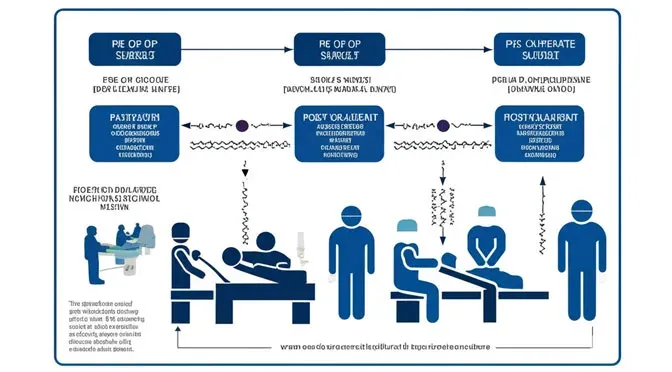
We wanted to find opportunities for process improvement, so we studied the combined pre-operative and post-operative (pre-op/post-op) area.
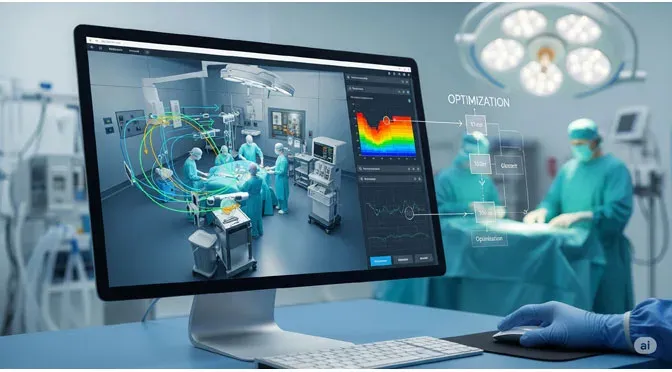
We knew static spreadsheets had limits, because averages cannot represent the dynamic nature of patient flow. We used discrete event simulation instead. This technique let us build a process digital twin of the facility, a virtual replica that models the system’s behavior over time and accounts for the variability in process durations and resource constraints.
Complexities solved by healthcare process simulation
Traditional methods struggled to deliver accurate insight. Three key factors could only be analyzed properly with healthcare process simulation:
- Variability in process times. Pre-op preparation, surgery, and room cleaning times are not fixed values; they follow statistical distributions. Relying on average times leads to inaccurate capacity planning. As the adage goes, “Using averages to calculate throughput is about as accurate as diagnosing a patient with a picture.”
- Limited cleaning resources. The availability of cleaning staff acts as a floating constraint. When several rooms become vacant at the same time, delays occur, because the limited cleaning resources must work through the backlog one room at a time.
- Shared resource constraints. The pre-op and post-op areas use the same physical rooms. A room occupied by a post-operative patient cannot serve a new patient until it is cleaned, which creates a circular dependency that is difficult to model without simulation software.
Our six-step healthcare process simulation approach
We followed a straightforward, six-step approach to build the model:
- Define system boundaries. We identified the pre-op/post-op area as the system of interest. The primary objective was to find the optimal number of rooms to minimize patient waiting times.
- Data collection. We gathered historical data on patient arrival rates and collected probability distributions for surgery and room cleaning times.
- Model development. We used ProcessModel and leveraged pre-built logic examples for handling resource availability. Today your own AI app can also build a model structure from a description of the process flow, through PM AI Bridge.
- Model validation. We compared the model’s output with historical data to confirm it reflected real-world behavior.
- Optimization. We defined a target waiting time, then used the optimization routine to calculate the optimal number of rooms and staff required to meet it.
- Scenario analysis. We ran the simulation with the optimized resource levels and watched the results to surface any hidden issues.
Key learnings and benefits
The project produced several useful insights:
- Simplified understanding. Healthcare process simulation turned an opaque system into a transparent model. The visual animation gave immediate clarity on bottlenecks.
- Data-driven planning. The optimization capabilities let us set resource allocation from real data instead of guesswork.
- Enhanced engagement. Showing that the digital twin mimicked the existing system was instrumental in earning the doctors’ trust.
- Non-intuitive insights. The simulation revealed interdependencies that traditional analysis never surfaced.
Looking ahead: the future of patient flow
We are eager to compare the real-world system against the model’s predictions. Based on a successful validation, we are confident the model will be a valuable asset. Our experience underscores the power of healthcare process simulation for tackling complex operational challenges and supporting data-driven decisions. For a closely related case, see how to reduce emergency room waiting time using process simulation.