

DMAIC is the problem-solving backbone of Six Sigma, the methodology for improving products and business processes. This article focuses on the business process side. DMAIC stands for Define, Measure, Analyze, Improve, and Control, and the approach works by finding and removing process defects to lift efficiency and effectiveness. The five steps are:
- Define the problem, then set specific goals and objectives for the project.
- Measure the current process to collect data and identify key performance metrics.
- Analyze the data to find the root causes of defects.
- Improve the process by developing and implementing solutions that address those root causes.
- Control the improved process with ongoing monitoring so the gains hold over time.
Sticking closely to the original DMAIC structure was always one of its great strengths, because projects followed a precise, repeatable pattern. As is often the case, though, a strength can quietly become a weakness. Easier communication also means more room for hacking. Faster, larger people carriers can move disease faster than at any time in history. In the same way, the rigidity of the DMAIC structure made teams slow to adopt techniques that would strengthen the method itself. Pratt & Whitney broke that pattern and raised their project success rate by building process simulation into their DMAIC work. Here is some of what they learned.
Improve the Measure phase
Pratt & Whitney, a leading manufacturer of aircraft engines and components, reworked its Measure phase around process modeling and simulation. The approach creates a digital twin of the production process that can be verified against the real system, giving the company a much clearer view of current parameters, behavior, problems, and bottlenecks.
What makes the digital twin so effective is that it moves. It far surpasses static data and becomes a living replica of the system under study. The twin captures:
- A logical process flow diagram. Every step and sub-step, from raw materials to finished product. Replicating the process makes improvement opportunities easier to spot.
- Resource assignments. When, where, and how available each machine and person is. Adjusting allocation reduces bottlenecks and lifts overall performance.
- Yield data and variance characteristics. Variation statistics expose quality and consistency issues that quietly drag down throughput.
- Process demand profiles. Overall product demand plus demand for specific components and sub-systems, so resources can be planned to meet customer needs on time.
- Load profiles. Workload and utilization across the line, highlighting both underused capacity and emerging bottlenecks.
- Idiosyncrasies of the production process. The unusual factors, such as seasonal swings or supplier availability, that disrupt smooth operation.
The payoff is a far better understanding of the current process. As one former employee put it, “it’s infinitely easier to fix the things you understand.” Modeling and simulation let the team see past static data to the behavior of the system, which, in their words, “has improved our ability to make profitable decisions.” With a model in hand, a change to any parameter ripples accurately through the whole system in seconds. There are no new calculations to run by hand; the model simply shows the effect.
Analyze
The Analyze phase breaks a subject into its parts and examines how they relate, surfacing patterns, connections, and underlying principles. The goal is genuine insight into the essential elements of the process.
In a traditional DMAIC project, analysis usually means running the numbers, observing the system, or asking workers what they see. Physically changing a production line to watch the result is rarely part of analysis, because doing so is expensive and disruptive. The digital twin removes that barrier. Pratt & Whitney could examine any aspect of a process in detail, watch the behavior and causes of an issue, make adjustments, and see the long-term consequences within seconds. That depth of analysis is simply out of reach for conventional methods.
Improve
The Improve phase now uses simulation to evaluate candidate solutions and identify the best one. Because the Analyze phase already revealed the process drivers and the constraints holding the system back, every improvement idea can be tested for its effect on the entire system before anyone touches the floor.
The optimization feature in ProcessModel goes further by finding process resonance, the state where all parts of the process work in harmony. With resonance, output rises with less effort, so it costs less to produce the required volume. Used well, this becomes a genuine secret weapon for tuning a process.
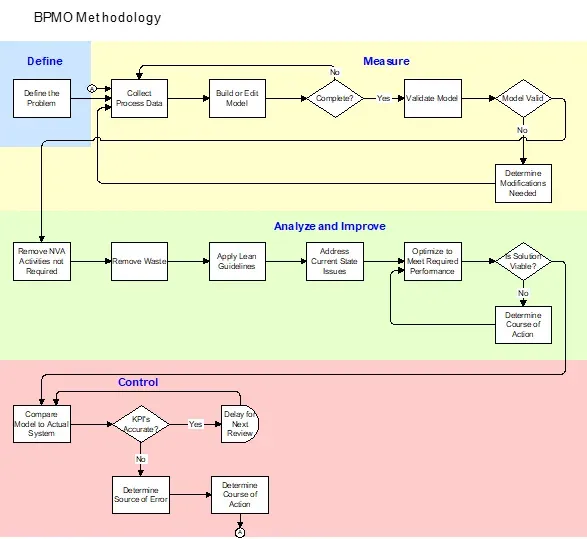
The diagram above shows how process modeling and simulation support and strengthen the DMAIC methodology.
Control
Control is the final phase. Here the improved process is locked in, properly implemented and maintained so it does not slide back to the old way of working.
The focus is to put the Improve-phase decisions into practice and set the new process up to succeed. To catch drift, compare the digital twin to the live process, then apply corrective action to bring things back into alignment. Done well, the Control phase makes sure the improvement is both well-implemented and sustained.
Process simulation simplifies decisions across DMAIC
DMAIC remains the dependable Six Sigma approach for improving business processes, and Pratt & Whitney made it stronger by adding process simulation. The model becomes a digital twin of production that clarifies the system’s parameters, behavior, problems, and bottlenecks, which in turn simplifies decision-making at every phase. If you want to put the same approach to work, see how ProcessModel handles simulation or explore plans and pricing.