

The problem
Where the time was going
Hangers, Inc., a central dry-cleaning facility in Austin, Texas, takes in clothes from a network of drop stores and cleans them with a liquid carbon dioxide process rather than the usual toxic solvent. As the business grew and two more drop stores came online, the owner needed to know whether the plant could keep up with the extra volume without adding overtime.
The team had already spent two years applying lean thinking with efficiency expert Dick Barry and had cleared the easy waste. The open question was harder: could the plant lift output sharply while holding the working week to 40 hours, and would new equipment pay for itself if they bought it.
What we modeled
Mapping the process, then testing the fix
They moved from trimming visible waste to building working models of the plant. Three were built in parallel, one for the current plant, one for the extended plant, and one for the lean extended plant, with the current model validated against real operations so everyone trusted that it matched the floor.
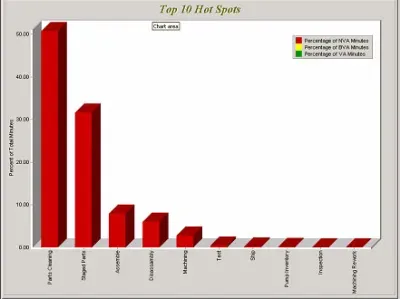
Each model carried its own measurements so a change could be judged honestly: process cycle efficiency, a Pareto comparison of twelve key activities to find the real bottlenecks, and labor utilization, since labor runs a quarter to two-fifths of cost in this business. The models then tested a continuous flow in place of batch and queue, two new work cells with cross-trained staff, tighter rework loops, and added capacity on four cells.
The result
The proof, and the payoff
At the start of the project the plant peaked at about 6,600 garments a week, and only by running a 14-hour day. The simulation showed management how to reach 10,000 garments a week on an 8-hour day by applying the lean changes, more output from a much shorter working day.
On the strength of the results, the plant changed its layout that year to absorb the additional garments coming in from the new drop stores.
- 10,000
- garments a week, up from 6,600
- 6 fewer hours
- in the working day, 14 down to 8
Part of our work in services.