

The problem
Where the time was going
After the Cold War, the United States and the former Soviet Union dismantled thousands of warheads, leaving a surplus of weapons-grade material. The two nations agreed to dispose of 68 metric tons of surplus plutonium, the equivalent of more than 7,000 warheads, by converting it into mixed-oxide fuel of roughly 95 percent uranium and 5 percent plutonium for use in commercial reactors.
Doing that required building a Mixed Oxide Fuel Fabrication Facility on an enormous scale: 500,000 square feet, more than 150,000 cubic yards of concrete, 31,900 tons of reinforcing steel, 3,366,000 linear feet of cable, and 70 miles of piping. Before any of it could rise, the contract required moving 750,000 cubic yards of low-level radioactive waste in a single year.
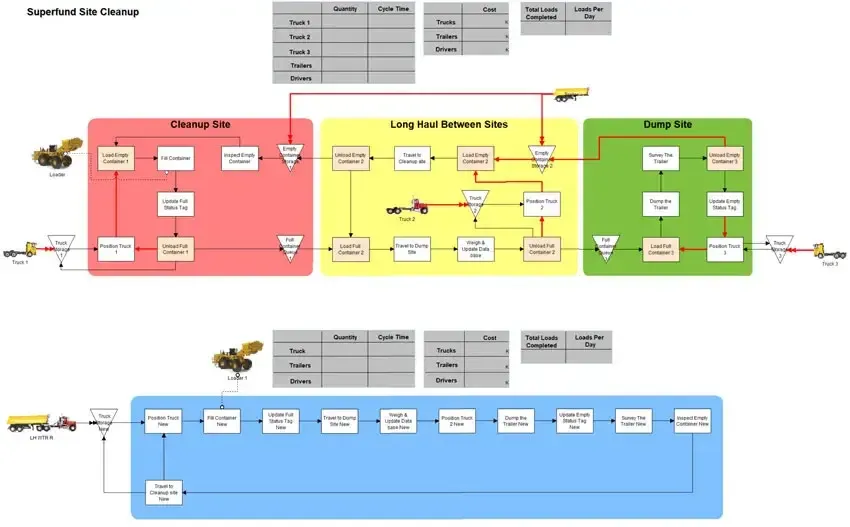
That translated into a daily quota of 150 trailer loads, with a $100,000-per-day penalty for falling short. Static spreadsheet math could not predict whether the operation would hit it, especially since the initial design forced six load-or-unload activities on every round trip and handed each load between three separate tractors for loading, hauling, and dumping.
What we modeled
Mapping the process, then testing the fix
ProcessModel built a working model of the waste transport and disposal operation, the kind of digital twin that surfaces bottlenecks a manual calculation cannot see. It captured the full round trip and the interdependencies and changeovers that a spreadsheet flattens away.
Run over a three-week period, the model showed that machines assumed to have ample capacity would actually become constraints once the system's shared resources and changeovers were accounted for. With the real flow in front of them, the team could test removing the unnecessary handoffs and the redundant equipment that the three-tractor design baked in.

The result
The proof, and the payoff
The model demonstrated clear efficiency gains by stripping out the unnecessary handoffs and the extra equipment, giving the operation a credible path to the 150-loads-a-day quota and away from the $100,000-a-day penalty.
Beyond the numbers, it became an indispensable teaching tool. Watching the system run made the interactions between loading, hauling, and dumping legible to everyone involved, which is exactly where static calculations had fallen short.
Part of our work in military and defense.