

The problem
Where the time was going
History records devastating pandemics. The Black Death killed more than 75 million people, the 1918 influenza pandemic killed 50 million, and a more recent influenza claimed more than a million lives. We are getting better at prevention, but much of the formula is out of human control, and a severe pandemic can still arrive when a virus mutates past our immunity, spreads easily, incubates quickly, and kills at a high rate.
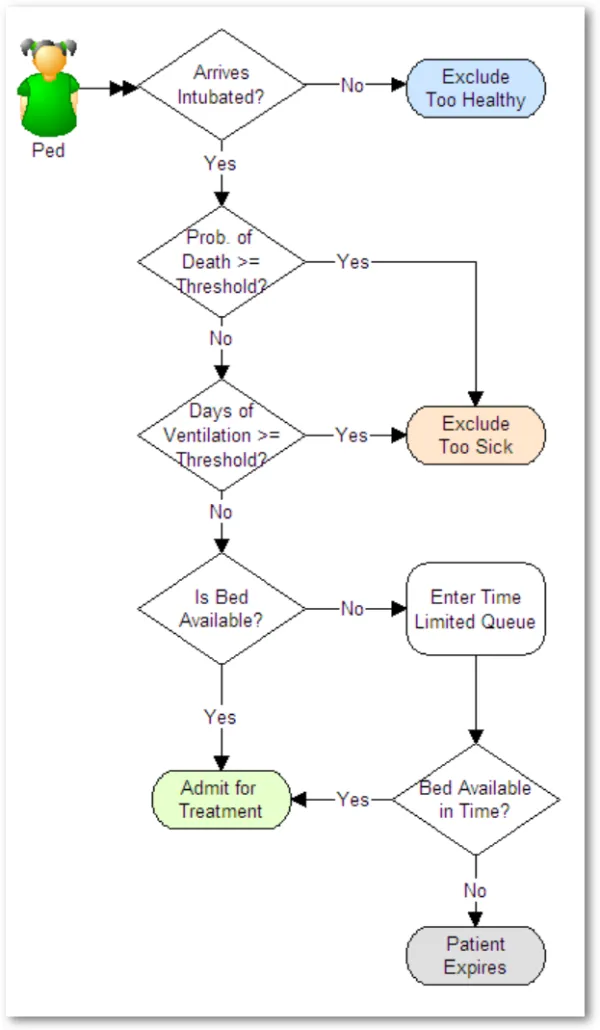
When the system is overloaded, every admission limits another, and unplanned decisions mean a hospital may treat patients who will not survive while missing those it could have saved. Triage, the assignment of degrees of urgency to decide the order of treatment, is how the most lives are saved when resources are scarce. The Center for Disease Control has endorsed triage allocation but will not recommend a specific algorithm, which leaves every hospital to decide on its own.
Strategies had been proposed, but no one had been able to quantify the value of putting one in place. This research set out to close that gap, using simulation and optimization to design a triage scheme that finds the best survival rate rather than guessing at one.
What we modeled
Mapping the process, then testing the fix
This is a research and modeling study rather than a customer engagement. Alex Kolker, in a peer-reviewed article in the journal Critical Care Medicine, used ProcessModel to demonstrate how an optimized triage algorithm could increase survival by almost 25 percent during a severe pandemic, the first time a particular triage scheme was designed this way to find the optimal survival rate.
The study let critical thresholds be tuned automatically against an objective function, a mathematical target that compared the result of every experiment. Built-in evolutionary algorithms generated many candidate solutions and kept only those that improved the objective, so only a small subset of many thousand possibilities had to be run to find the optimal thresholds. The objective weighted reducing mortality at twice the weight given to bed occupancy, factoring in the size of the pandemic, the pattern of patient arrivals, the probability of death treated and untreated, days of ventilation needed, and beds available.
The result
The proof, and the payoff
The study analyzed close to one million historical patient records of similar respiratory conditions to derive the algorithms behind the model, with people from healthcare, statistics, and public health taking part. The finding is hard to ignore: an improvement of about 25 percent in lives saved during a severe pandemic, achieved by optimizing how scarce care is allocated.
The result stands as research rather than a deployment, a quantified case that a well-designed triage strategy measurably raises survival. Alex Kolker has published widely on hospital flow and staffing, and this work extends that record to the question of how to save the most lives when a pandemic overwhelms capacity.
Part of our work in healthcare.