


The problem
Where the time was going
The company adds reflective material to existing garments, turning everyday workwear into all-in-one safety products that customers prefer over pulling a separate vest over a coat. The market was real and the product was strong, but the path from interest to order was painfully slow. The sales cycle averaged nine months.
The original goal was modest: trim the cycle from nine months to five, with only four months available to do the work. Four months was not even long enough to watch a single cycle run start to finish, so the team could not simply observe and tune. They had to understand how the stages interacted before they could shorten anything.
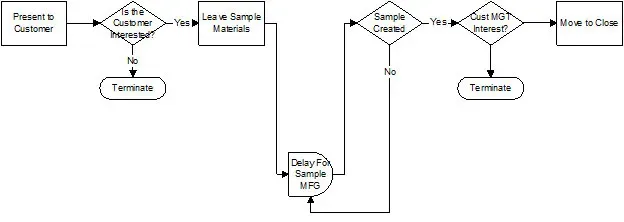
When the time was mapped stage by stage, the answer was uncomfortable. Prospects were enthusiastic at the first presentation, but deals stalled on one step: the company had to produce a sample garment before a customer would commit, and 85 percent of the total waiting time traced to customers sitting on that single request.
What we modeled
Mapping the process, then testing the fix
Because a full cycle could not be observed in the time available, the team gathered data from each segment of the process and used the model to study how those segments fed one another. ProcessModel mapped the full sales cycle from first contact to closed deal, and the Hotspot Evaluator pinpointed exactly where the waiting accumulated.
With the constraint in plain view, the model became a place to test ideas without risk. The breakthrough was simple once the data made it obvious: instead of waiting on the customer to act on sample materials, the company would make the samples itself. The model tested a flow where a customer named three products, an in-house seamstress built the examples overnight, and finished garments went back the next day while interest was still high.
The result
The proof, and the payoff
The simulated change held up, so the company put it into practice. The sales cycle fell from nine months to about five weeks, a reduction of 87 percent, far past the original target of getting under five months.
Management worried at first about the cost of an extra resource working overnight, but the model made the payoff visible before anyone committed, and the impact won them over. The work that used to stall now moved, because the step that caused the wait no longer depended on the customer.
Part of our work in logistics.